


Quick summary:
Podcasts hold hours of experts explaining their own work, and once an episode ends, finding a particular claim again means scrubbing through the audio. Platform transcripts and a handful of free tools can turn any episode into text fit for research, with the studies behind the conversation a click away. Simple checks then sort the rigorous shows from the rest and trace a spoken claim back to its study.
Key takeaways:
→ Podcast claims travel by word of mouth more often than by citation. A remark heard once gets repeated far beyond the episode, and going back to confirm the wording or the evidence is rare.
→ The largest audio apps now produce transcripts on their own, and paste-in websites handle the shows they miss. With text in hand, a timestamp pins a spoken claim the way a page number pins a printed one.
→ The most rigorous shows publish the studies and books behind each episode right in the episode description. Those lists separate the shows built on evidence from the rest, and they let a listener read what the expert read.
→ The same approach works on lectures and oral histories as readily as on podcasts. Speech that becomes text becomes verifiable, as more of what people know arrives as speech every year.
Scroll to the end for a recommended podcast list.
In the summer of 1933, a Harvard classics professor named Milman Parry made his first trip to what was then Yugoslavia. He carried a question that had gone unanswered since antiquity: how could the Iliad and the Odyssey, poems far longer than anyone could memorize word for word, have been composed in an oral tradition? The mountain villages of the Balkans were still home to illiterate bards who could sing heroic epics for hours at a stretch. Parry believed their way of composing was the same one that had produced the Homeric poems; recording them meant watching the ancient method still at work.
He returned the following year with a former student named Albert Lord, and this time the recorder was a custom rig: two turntables that handed off to each other so one could keep cutting a disc while the other was swapped, letting a performance run for hours without a break. Over fifteen months the two of them gathered more than twelve thousand texts, most taken down in writing and many recorded onto aluminum discs, more than three and a half thousand of them in all. Alongside the discs were ninety-five notebooks of texts taken down by dictation. What began as spoken sound became a written archive, and that archive became the foundation for how scholars understand the oral-traditional composition of the Homeric poems.
For most of history, the only way to keep something said aloud beyond the moment of its utterance was for a person to write it down. Some speech survived that way, in court records and in sermons a listener copied out. Transcription by hand was slow work, though, so those were the exceptions, and ordinary talk left no record. What Parry grasped, before magnetic tape became commonplace or digital audio existed, was that a recording is only half of the value. The other half arrives when the recording becomes text a person can search and quote.
An archive disguised as entertainment
More than half a billion people around the world now listen to podcasts, across more than four million shows. Buried in that catalog is a kind of source material that barely existed a generation ago: experts talking about their own work, at length and in their own words. On one show a scientist spends an hour on the false starts behind a published result, the kind of detail a formal paper leaves out. Another has a historian naming the exact archives behind a claim, and elsewhere people who will never write a book sit for long interviews about what they know.
The candor is one part of the value, and the paper trail is another. A published article shows conclusions, and an interview lets us hear the same person explain how they reached them and where they still hedge. The most rigorous shows then post every study and book mentioned in the episode’s notes, so a single conversation can hand us a reading list. And because shows publish in dozens of languages, the catalog reaches experts whose work never gets translated into English at all.
Some of what’s in there exists nowhere else. Plenty of expertise never gets written down at all (for example, the tacit working knowledge of surgeons, engineers, negotiators, and builders) and a long interview can be the only record of how those people think. Timing favors the medium too, since a researcher can talk through a finding the week it publishes, months before any writing that digests it could arrive. And when an interviewer pushes past a rehearsed answer, we hear something print rarely captures: an expert responding in the moment.
The clearest proof that podcasts already work as sources is how often we quote them. “I heard on a podcast” has become a standard way for a claim to enter conversation, and a statistic from an interview gets repeated at a dinner table, then again in someone’s article. Each repetition runs on memory alone. An episode link exists to send, but it opens an hour of audio with no page number, and the claim sits somewhere inside, unmarked. So the archive is already in use as a source, just without a way back to the moment, and a claim nobody can return to is a claim nobody checks.
Newsrooms already treat podcasts as source material, since a remark a public figure makes on a show routinely becomes a headline, and enough demand exists that a small industry of transcript and search tools has grown up to serve that work. So the archive has two kinds of users: professionals who mine it with purpose-built tools, and the rest of us who quote it from memory. The gap between the two is awareness, since most of us never learn the material can be searched and cited at all.
Part of why we never learn is mechanical: a conventional search engine can’t reliably search what’s only been spoken. Google, for example, can find an episode when the topic made it into the title, the written description, or an indexed transcript, but everything else—the claim made at ninety minutes in, or the study a guest named in passing—may exist only in the audio, so no typical search box will surface those words. What a search engine sees of a podcast is often the label on the box; the contents inside stay sealed.
Librarians have a name for a similar issue. Grey literature is the term for knowledge produced outside the usual commercial or academic publishing channels: government reports, working papers, conference talks, and other material that may be valuable but poorly indexed. Podcasts don’t fit the category neatly, but millions of hours of recorded expert conversation can present the same practical problem. Reaching material like that takes method: knowing where it collects, and knowing how to pull it into a usable form. For podcasts the method runs in a fixed order, and here we’ll walk through it step by step: first turning the audio into text, then finding the right shows and episodes, then checking the claims and the people who make them, and finally citing what survives the scrutiny.
Plenty of transcripts already exist
Often the first step, audio into text, is already done for us. Several of the biggest podcast platforms now generate transcripts automatically for many episodes, and each keeps the text in a different place. Platforms may create these on their own, whether or not a show publishes a transcript itself. Here’s what each offers, with the steps for opening the text.
Spotify
Spotify can show the full text of an episode while it plays, the way a music app shows lyrics. The line being spoken is highlighted, and the text scrolls in time with the audio.
Important: We must use the official Spotify Desktop App installed on our computers. If we’re using a standard web browser, the transcript features won’t show up at all.
To find the transcript:
Play the Episode: Open the desired podcast episode and click the green Play button.
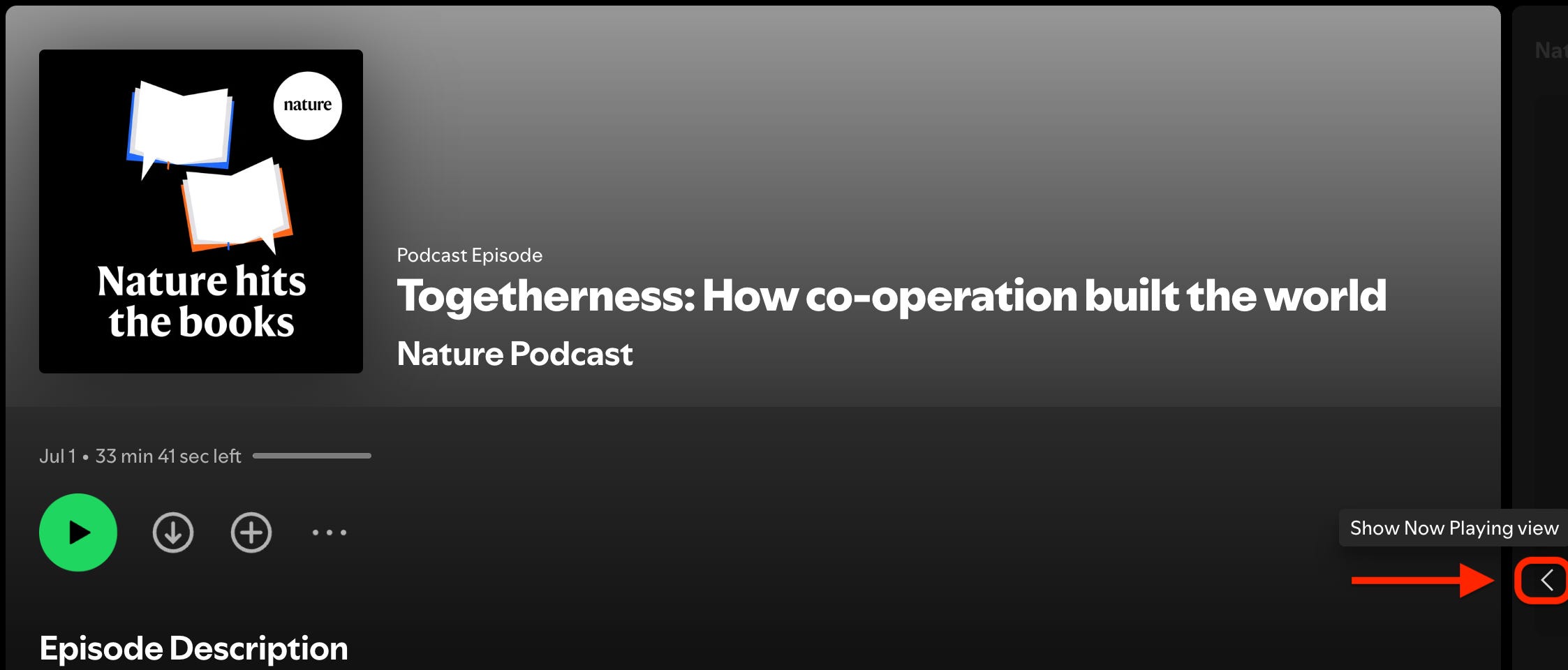
Open the Right Sidebar: Look at the far right edge of the screen next to the main window content. Click the arrow button facing left that says Show Now Playing view when hovering over it. This slides open a wide menu pane on the right side of the screen.
Scroll the Sidebar Down: Move the mouse cursor into that newly opened right sidebar. Scroll down completely past the cover art, the episode description, and the Comments section.
Locate the Read Along Panel: Look right below the About the podcast block. If a transcript is available, a section titled Read along or Transcript will appear displaying the scrolling text. Tapping any line of text automatically moves the audio playback to that exact moment.
Spotify hasn’t generated transcripts for every episode. When an episode has none, no transcript option appears, and the tools in the next section fill the gap.
Apple Podcasts
Apple generates transcripts as well, and the company says more than one hundred million episodes now carry them (across thirteen regional versions of languages).
Important: We must use the official Apple Podcasts App installed on Mac computers. While there’s a web version of Apple Podcasts, the interactive transcript feature is entirely unavailable when listening through a browser.
To find the transcript:
Play the Episode: Open the desired podcast episode and click the Play button.
Open the Full-Screen Player: Tap the MiniPlayer bar stretching across the bottom of the screen to slide open the full-screen playback view.
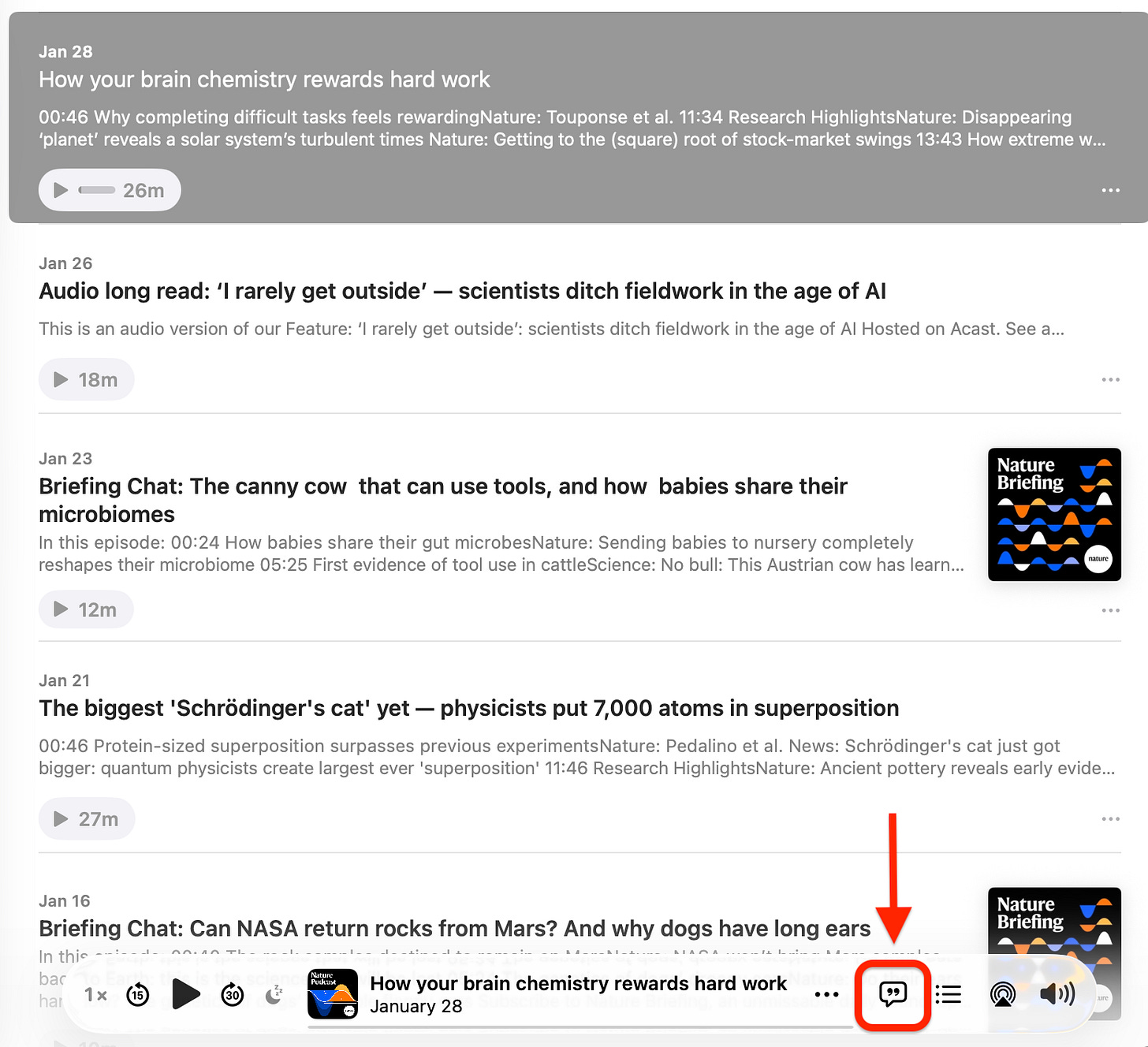
Tap the Transcript Icon: Look at the bottom-left corner of the full-screen player screen. Tap the speech bubble icon that looks like a quotation bubble with horizontal lines inside.
Navigate the Text: The transcript will open in full screen and automatically scroll in sync with the audio. Tapping any line of text automatically moves the audio playback to that exact moment.
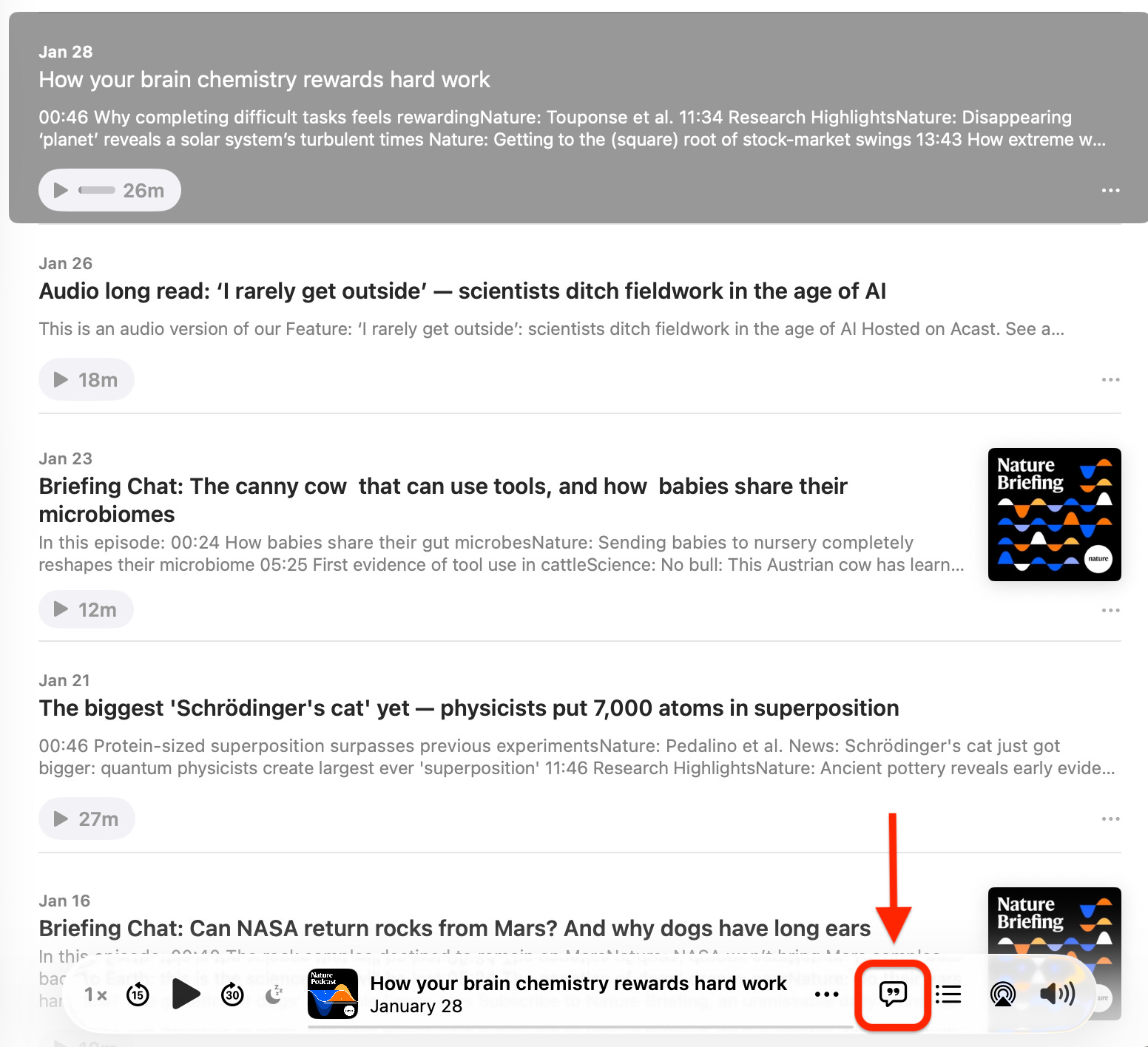
Apple hasn’t generated transcripts for every episode. If we don’t see it, or if the icon is grayed out, that means that it’s not available. Same as for missing Spotify transcripts, there are options in the next section that can help in this kind of situation.
YouTube
Many podcasts also appear on YouTube as video. When a video has captions, YouTube provides an interactive transcript text block that’s useful for locating key terms.
To open the transcript:
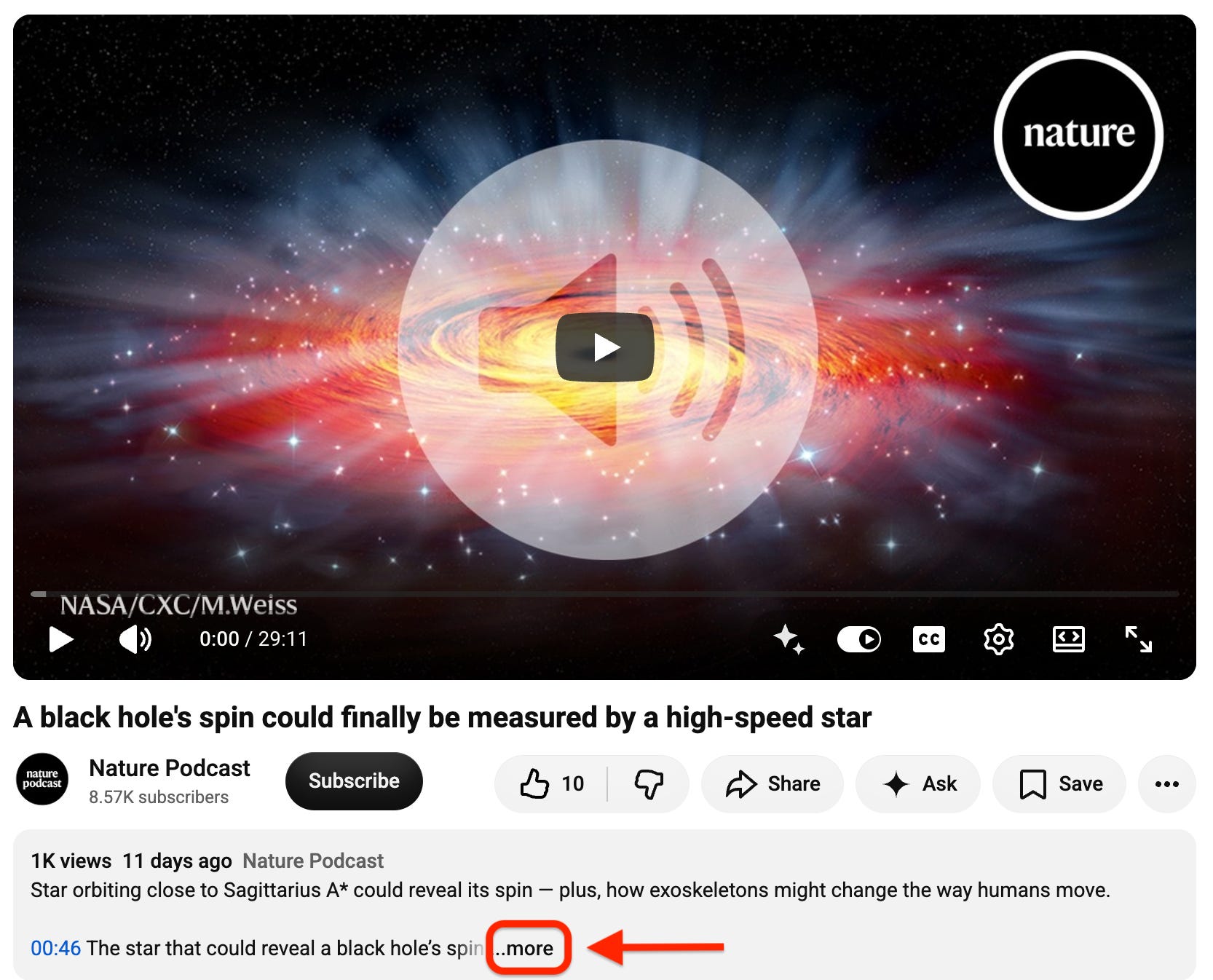
Expand the Description: Locate the gray description section box directly underneath the video player screen. Click the ...more button to expand the text box completely.
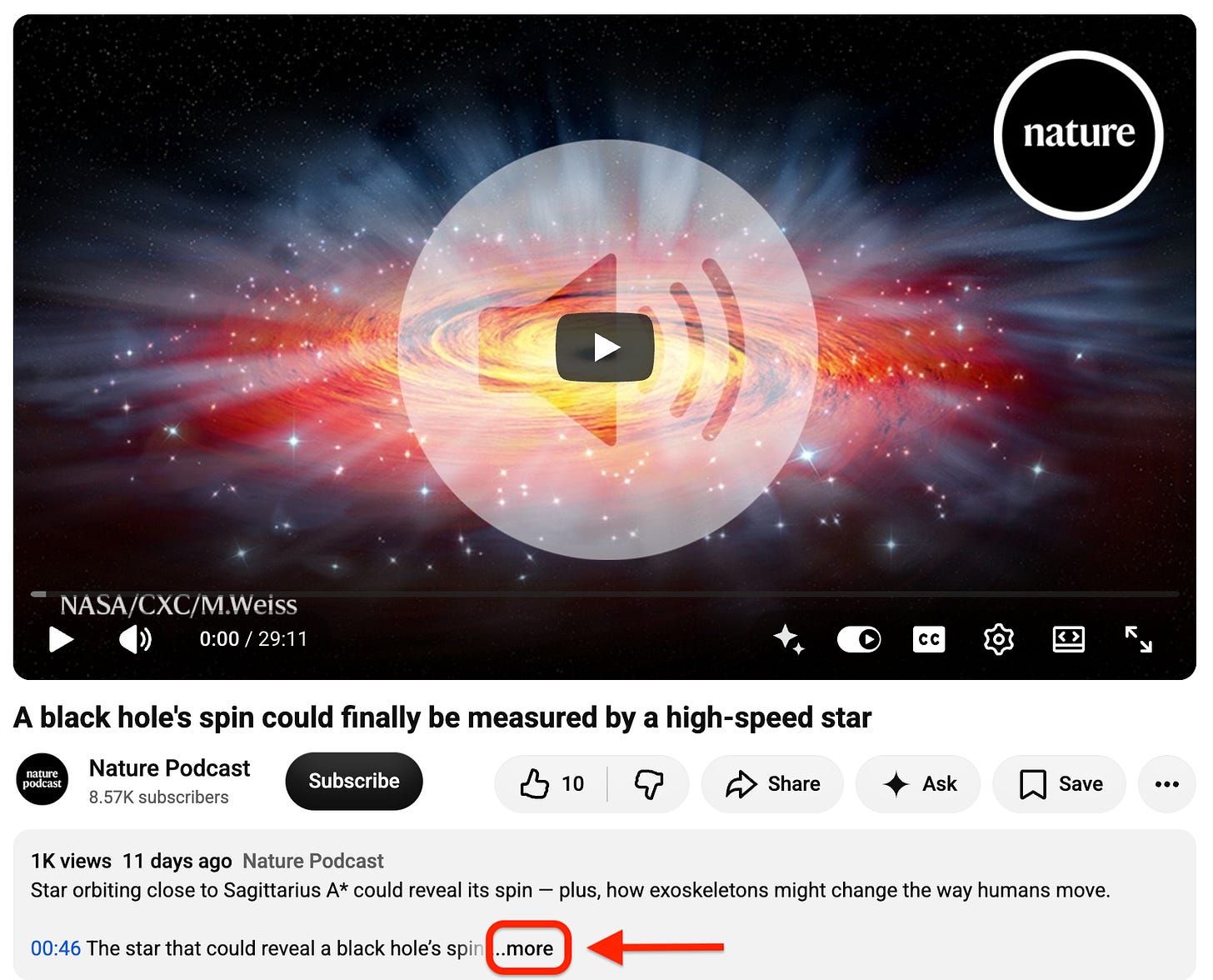
Open the Transcript Window: Scroll all the way to the bottom of the items inside that description section. Click the button labeled Show transcript. A dedicated transcript window will immediately slide open on the right side of the video player screen.
Search for Keywords: Move the cursor inside that right sidebar text block. Press Command + F on a Mac, or Control + F on Windows, to search for a specific name, phrase, or term.
Navigate the Video: Click any timestamped line of text inside the scrolling layout to automatically move the video playback to that exact moment.
YouTube can also translate the captions displayed during playback:
Open Player Settings: Hover over the video player screen and click the Settings gear icon located on the bottom toolbar.
Select Translation: Click Subtitles/CC, click Auto-translate, and select the desired language from the list.
When we turn on auto-translate, the new language only shows up as subtitles on the video screen, while the transcript text box on the right side of the screen stays in the original language. This means we can’t search or copy the translated words from that sidebar. Computer translations also frequently make mistakes with names and lose subtle meanings. While this feature helps us understand the general conversation, we shouldn’t rely on it for exact quotes.
For transcripts that aren’t readily available
If an episode lacks a native transcript, no panel or button will show up on its page. We can easily fix this by generating a text file directly from the audio using an external tool. These tools come in two forms: websites where we paste the episode link, or software programs that run locally on our own computers.
Paste-the-link generators
These are websites that create the transcript for us. Paste in the link to an episode, and the site returns the full text, broken into timestamps.
Podtyper works from a public Apple Podcasts, Spotify, or YouTube episode link.
TranscribeTube works from a YouTube link or an uploaded audio or video file, and it can label who’s speaking (which helps on a show with several guests).
Unlike the read-along panels inside Spotify and Apple, these services return a file we can save and mark up.
Whisper, for private or bulk transcription
Whisper is an open-source speech-recognition model released by OpenAI. It can run on our own computers, so the audio stays local on the machine. The practical way to use it is through an app built around it, such as MacWhisper: open the app, drop in an audio file, and the transcript appears.
For long-running podcasts, high volume is the best reason for its use: it can process a show’s back catalog in batches. It also handles audio that was never published at all (like our own interview tapes or a family’s oral history). When we use a local transcription model, those files stay on our own devices. (And to clarify, it’s unrelated to Wispr, the dictation app with the similar name.)
Looking beyond Spotify, Apple, and YouTube
Those three platforms have the easiest transcripts to reach, though podcasts play in dozens of other apps as well, with many drawing on the same public feeds. Wherever we listen, a more difficult question could be sitting underneath: which shows should we be following at all? A separate set of sites exists for answering that.
Where to find shows in the first place
These sites help us browse and search the shows themselves, by topic and, in some cases, by guest.
Podchaser catalogs shows and their guests, the way a film database catalogs movies and actors, so searching a researcher’s name can turn up shows they have appeared on.
Goodpods surfaces shows that other listeners recommend.
The New Books Network runs episode after episode of scholars interviewing scholars about their new academic books, sorted by field.
Podcast Index is an open podcast directory and database that makes public podcast feeds searchable.
The charts inside the big platforms rank shows largely by popularity. But popularity can be built with marketing, and offer nothing about whether a show’s claims and sources hold up under scrutiny. These directories offer other ways in: topic, guest, category, description, ratings, reviews, and editorial or listener recommendations. That makes it easier to find a small, rigorous show that might otherwise be buried beneath a heavily promoted one.
How to search every show at once
A directory surfaces shows to follow, and sometimes the question is narrower: which episode, anywhere, discussed a topic or quoted a researcher. Often those words can make it into an episode’s title or description, and a regular search, or Listen Notes below, will turn them up. But when they were only ever spoken over the course of the episode, transcript search engines take over.
Listen Notes
Listen Notes is a search engine for podcasts, the way Google is a search engine for the web. It indexes millions of public podcasts using the feeds shows themselves publish. Type a phrase or a name and it returns matching shows and episodes, searched across titles, written descriptions, show notes, and, where available, transcripts. It works like a card catalog for podcasting at large, the first place to look when the question is which show covered a subject at all.
Tapesearch
Tapesearch searches podcast transcripts. It has generated text for a large catalog of episodes, and typing a term returns matching passages, each with a timestamp that takes us to the moment in the audio. Exact phrases can go inside quotation marks, and search terms can be combined. For research that starts from a term and needs to find where it came up, this is the tool.
Podscan
Podscan is Google Alerts for podcasts. Give it a name or a topic, and it searches its transcript database and monitors new episodes as they publish, flagging mentions whether or not they ever reach a title or description. The other tools here help search what already exists; Podscan also keeps watch going forward, which is how a researcher tracks a topic over time and how anyone finds out they’ve been mentioned on a show.
Snipd
Snipd is built around saving and searching the parts of episodes we care about. As we listen, it lets us clip a moment, and it saves that clip with a transcript, timestamp, and summary in a personal library we can search later. Over time this becomes a searchable record of the passages we marked across everything we’ve heard.
Show notes are the works cited
Everything so far ends with words on a screen, an episode found and its transcript in hand, and words alone only prove what someone said. Checking where the words came from (that is, the provenance of these ideas) starts in the same place on every episode: the show notes, or the episode description that the show itself wrote. On most shows it carries a summary and some promotional links. The most rigorous shows use it for something else entirely: a list of the studies and books the conversation touched, with links straight to the original sources.
This is where a podcast stops being testimony and starts becoming scholarship we can verify. An expert’s spoken claim asks for our trust, and a works-cited list lets us check before we give it. With this, we can open the same papers the expert read and see whether the claim survives the trip back to its source. Whenever an episode raises a claim we plan to repeat or rely on, having these sources available allows us to read what the speakers themselves were reading and come to our own critical conclusions.
Coverage varies from show to show, and that variation can tell us something about a show’s reporting and editorial practice. Science shows tied to institutions, and interview shows that take sourcing seriously, may publish full lists of studies and books. Peter Attia’s medical show often links studies and other resources discussed in an episode, and Ezra Klein’s interviews commonly include books mentioned in the conversation and the guest’s recommendations. To find the notes, open the episode’s page in any app and expand the description. When the in-app version looks cut short, the show’s own website may carry a fuller version under the episode’s title. An episode with nothing there beyond links to sponsors has answered a question too: how much of its source trail it’s made available.
How to verify a show
The show behind an episode deserves the same scrutiny as the episode itself. Podcasting has no universal editor, reviewer, or publisher standing between a host and our ears. Anyone can start a show, and sounding authoritative is a production choice, open to anyone with a microphone. So the question of who’s behind a show comes before anything the show says.
Three quick checks reveal a great deal about a podcast:
Search the host’s name: Relevant training, an institutional affiliation, or a career in the subject may surface quickly, along with interviews, reporting, criticism, and other evidence of how the host is regarded.
Open an episode’s notes: A rigorous show may link its sources there; a show with nothing but sponsor links leaves its evidentiary trail harder to inspect.
Scan the guest list: Working researchers and practitioners, whose names and work can be independently confirmed, are a useful sign that a show draws on real expertise.
There’s another shortcut for the moments when a host or guest’s name is already in hand. We often arrive at a topic from somewhere: an article that quoted an expert, or a study with an author. Podchaser can turn that name into a list of shows the person has hosted or appeared on. One search opens a shelf of candidates, each tied to someone whose work sent us looking.
Two deeper marks distinguish the strongest shows: a named institution or a stated corrections practice standing behind the work, and openness about the show’s own point of view on controversial ground. Both tend to show up on a show’s About page, as one more place to look. And production polish counts for nothing on its own: a show can be popular and beautifully produced and still cherry-pick the studies that fit its story.
How to verify what we hear
A vetted show narrows the risk, but each claim still calls for its own check because speech and print run on different standards. In conversation, an expert may speculate and simplify in ways they would rarely put in print (since talk often goes out with no peer review and less editorial scrutiny). A remark on a podcast reads best as a lead: dependable evidence of what the expert said and a pointer to published work, where a claim can be checked before we repeat it as true.
Suppose an episode claims that 80% of adults with ADHD dread replying to text messages. Before that number travels further, run it through the same checks a statistic in an article would get:
Open the show notes and look for the study behind the number. If it’s linked, read what was measured and in how many people, since a statistic often changes shape between the paper and the retelling.
If the notes name no source, search the claim itself: the key terms and the number, in Google Scholar or a regular search, to see whether any study produces that figure.
Check the speaker too. A search on the expert’s name and field can turn up their training and what they have published, which helps distinguish a researcher describing their own data from someone repeating something heard elsewhere.
A claim that traces to no study and no named data is an opinion, a hypothesis, or an unsupported assertion. Repeat it as such, or drop it.
Two cautions apply to the transcript itself. Automatic transcription mishears exactly what research leans on—proper names and figures—so before quoting anything word for word, open the audio at the timestamp and confirm the words by listening. And an contentious clip calls for the full episode, since audio can be cut in ways that reverse a speaker’s meaning, and synthetic voices are now convincing enough that a clean recording is no longer proof a person said the words. Finding the moment inside the full, original episode answers both concerns.
A long interview also offers something no pulled quote can carry. Across an hour we hear how an expert reasons, which evidence moves them and where they still hesitate. Lift one sentence out and that context drops away, which is how a hedged, qualified statement turns into a confident-sounding claim it never was. So the transcript earns its keep twice: once as a source of quotes and once as something to read in full, for the reasoning around them.
The form itself also works on us in a way print simply can’t. Hours of a voice in our ears can build the feeling of knowing the speaker; we may extend to familiar voices trust we would withhold from an unfamiliar claim on the page. A claim from a familiar voice can slip past the scrutiny we would give the same words from a stranger. The fix here is running the claim through the same checks anyway, warm familiar voice or not.
And one more bias sits underneath the medium itself. The experts who show up on podcasts are a self-selected group: the ones willing to sit for an interview and are at ease behind a microphone. Researchers who never record anything may vastly outnumber those who do, so the voices that reach us are one slice of a field, not necessarily a representative one. That gap is easy to forget when a well-argued episode starts to sound like the consensus of an entire discipline.
How to cite a podcast
After the episode is found and the claims are checked, one question is left for anyone writing a paper or a report: whether a podcast can go in the citations. It can! Citation systems have long covered recorded speech, and the style guides that govern academic writing include formats for podcast episodes. A podcast is fully legitimate as a primary source when it’s cited as evidence of what a person said, much as an interview or a speech is cited.
For a claim, though, the episode is often a conversation about the evidence. The study a guest discussed is the citation for the finding, and the episode is the trail that led there. The rest of us might not need to keep citation lists, but the habit still pays off in a smaller way: sending the timestamp and a link along with a claim lets the other person hear the moment for themselves.
A workable general citation names the creator or host, the episode title in quotation marks, the show title in italics, the publisher, the publication date, and a link to the episode. Add a timestamp when you are quoting or directing a reader to a particular claim. Include a retrieval date when a required citation style calls for one, or when the episode is unusually likely to change or disappear.
Pattern: Host or creator, “Episode Title,” Show Name, publisher, publication date, URL; timestamp for the quoted passage.
Example: Nature Podcast, “A black hole’s spin could finally be measured by a high-speed star,” Nature Podcast, Nature, 19 August 2026, [episode link]; 00:46.
Anyone who reads that citation can open the episode, move to 00:46, and hear the claim being made, much as a page number sends a reader to a passage in a book.
Listening like a researcher
With a transcript open and the sources in hand, an episode becomes something we can return to and question. A claim that catches our attention in minute forty no longer has to survive as a half-remembered remark. We can find the line again and follow where it points. The standards we already use on writing can now apply to what we hear.
A good podcast can do more than deliver an answer. It can lead us to a researcher’s work, a book, a paper, an archive, or a disagreement that the conversation only had time to touch. An interview may be the first place we encounter a question, not the final authority on it. Once the words are searchable, the episode becomes a way into a larger body of work. That possibility changes the listener’s role. We can admire an argument and still look at its evidence. We can take an expert seriously without accepting a spoken claim before we’ve seen what supports it. When the source holds up, we know where it came from. When it doesn’t, the search has still shown us something about the limits of the claim.
The tools that make this possible once belonged largely to newsrooms and research institutions. Transcripts, searchable audio, and episode notes have made more of that work available to anyone willing to use them. A listener who opens the notes and follows a source also changes the incentives around the medium. Shows have a reason to document their claims when listeners expect a trail they can inspect.
Recorded talk has always carried knowledge that doesn’t appear elsewhere: the texture of an interview, the hesitation before a conclusion, the working memory of a field, and the account of someone who may never write a book. What’s changed is our ability to return to it. What lectures, oral histories, conference sessions, interviews, and the meetings workplaces save for later can increasingly be searched, read, verified, and cited. A transcript leaves the listener with more than a voice to remember: it leaves the words where they can answer for themselves.

A few readers have asked how to support the work outside of a subscription, so here’s another option. If something here has resonated with you or been helpful, this is one more way to show appreciation. Thank you for reading, always!
You might also like:
The Atlas of Learning: A librarian’s map of where knowledge lives, and how to find our way through the research world.
YouTube is a Research Library. Here’s How to Search It Like One.: 30 YouTube tools to find exactly what you need, and the verification framework underneath all of them.
What “Do Your Own Research” Actually Means: A step-by-step methodology for evaluating any claim and exploring any subject.
The free essays are the foundation. The paid tier is where information literacy becomes a skill you can use: the Card Catalog Classroom with its searchable Reference Collection and structured lessons across four learning domains, plus biweekly AI Briefings, monthly Librarian Hotlines, and quarterly deep-dive guides.
Upgrade to paid for the full Card Catalog. Thank you for being here!
The recommended shelf
For anyone who wants somewhere to begin, these are shows that offer strong reporting, knowledgeable hosts or guests, and a visible trail back to sources. They run in several languages and reach well past the English-speaking world. Many publish on YouTube or post useful notes and links, so the transcript and search methods above will often apply. It’s a starting point for reputable podcasts out there, not the final say on which ones to trust.
Science
The Nature Podcast (English)
Produced by the journal Nature, with reporting tied to newly published research and links to papers behind many stories. It runs as a brisk news briefing, and a single episode can lead to a study behind a recent finding.Science Vs (English)
Wendy Zukerman takes controversial questions through the available research, with a comic touch and source lists in the notes.Ologies (English)
Alie Ward interviews specialists from a different field in each episode, warm and quick, with further reading and source links in the notes.Coffee Break: Señal y Ruido (Spanish)
A weekly Spanish science roundtable, loose and argumentative, that reads recent papers and reports back. The show describes itself as separating sound science from noise.Naruhodo (Portuguese)
A Brazilian show that takes questions from science and everyday life through evidence and explanation. Verify the relevant episode notes when using it as a source.The Science Show (English)
ABC Radio National’s long-running science program, presented by Robyn Williams and Belinda Smith. It brings researchers into conversations that range widely across contemporary science and scientific debate.
History
The Rest Is History (English)
Historians Tom Holland and Dominic Sandbrook talk a subject through across several episodes at a time, from antiquity to the twentieth century. The archive runs past eight hundred episodes, and the British Academy gave the show its President’s Medal (a first for a podcast).
Empire (English)
Historian William Dalrymple and journalist Anita Anand cover the world’s empires, from the Mughals and the Ottomans to the British. Academic guests come in for the ground each knows best, and the questions stay on how empire made the present.
Le Cours de l’histoire (French)
France Culture’s daily history program, presented by Xavier Mauduit, with historians discussing their research and recent books.Geschichten aus der Geschichte (German)
Two historians take turns walking each other through a story from the past. It’s a weekly, source-conscious show with a large back catalog.Il podcast di Alessandro Barbero (Italian)
These unofficial feeds gather public lectures by the medieval historian Alessandro Barbero into an enormous history archive. The scholarship and voice are Barbero’s, though the selection, framing, and feed management belong to unofficial publishers.Fall of Civilizations (English)
Paul Cooper’s long, atmospheric episodes examine societies in crisis and collapse, global in scope and accompanied by source lists.Revolutions (English)
Mike Duncan’s narrative history follows the major revolutions from the English Revolution through the Russian Revolution. Its ten-season original run remains a patient, evenhanded course in political upheaval.COTEN RADIO (Japanese)
A Japanese history podcast produced by COTEN, a company that organizes historical research and turns it into long episodes on figures, events, and civilizations.The Ancients (English)
Tristan Hughes interviews a different historian or archaeologist each episode on one theme from antiquity, twice a week. The guests are working academics, and the notes link their books and the related episodes.
The History of Africa Podcast (English)
A narrative history of African empires, kingdoms, and societies that takes a deliberately non-Eurocentric approach.
Big ideas and long-form interviews
Sean Carroll’s Mindscape (English)
The physicist Sean Carroll interviews people working across science, philosophy, and public life. Conversations can become technical, and their value often lies in hearing specialists pursue an idea at length.Dwarkesh Podcast (English)
Dwarkesh Patel conducts unusually long, closely prepared interviews on artificial intelligence and frontier science. Use each episode as an opening into the guest’s work, not as a substitute for it.Conversations with Tyler (English)
Tyler Cowen’s fast interviews range across economics, culture, technology, and public life. He often approaches economic questions from a classical-liberal perspective, a useful lens to keep in view.The Seen and the Unseen (English)
Amit Varma’s extended interviews move through India’s economy, politics, history, and culture. The show's notes can be unusually extensive, and Varma brings a declared free-market sensibility to the economics.
I work with Audiogram API, so this caught my attention. How do you usually share a useful bit from a podcast with someone? Do you send the episode and a timestamp, or pull out the quote? Curious whether people actually go back and listen.
Thank you so much for this. I work in podcasting and you discover to me some interesting tools and series