


Many of us have lost the ability to read the way we once did. The desire is still there, and the books still come home from the store. What has slipped away, almost without our noticing, is the old capacity to sink into one and stay there. We sit down with good intentions and last a few pages before the mind drifts off while the eyes keep moving, and we reach the bottom of a page with no idea what it said. The same sentence gets read three times over. The phone we promised to leave in the other room somehow ends up back in our hand. An hour with a book, a stretch that once passed comfortably, has become a feat of concentration that leaves us wondering what changed.
Reading at length is a physical and mental skill, built by practice and weakened by neglect—no different in that respect from the stamina to run a distance or carry a conversation in a second language. Years of reading in snatches, on screens, between the thousand small interruptions the screen invites, can train our attention toward speed and away from depth. The muscle for a long, unhurried text has gone slack from disuse, and the book that once carried us for an hour now loses us after a few pages. A slack muscle, though, is one we can train back to strength.
Part of what changed is physical, down at the level of the eye. Reading a printed line mostly relies on rapid eye movements called saccades, with brief pauses between them where the eye takes in the words before moving on. Scrolling often engages a different pattern: the eye can track text or other content sliding up the screen and follow it, the way it would track a bird across the sky, using what researchers call smooth pursuit. Heavy, habitual up-and-down scrolling likely gives that continuous tracking motion more practice, while the stop-and-go left-to-right rhythm that carries us through a printed page gets less exercise. What the evidence supports is the broader point: the difficulty sits largely in habits we’ve learned rather than in any fixed flaw within us. The feeds that trained us into scrolling were built by teams whose success is measured in how reliably they can pull our eyes back to the screen. Years spent inside that design leave their mark on how we read, and habits built by practice can be rebuilt the same way.
The screen-reading penalty has been measured directly. A 2018 meta-analysis in Educational Research Review pooled more than fifty studies comparing how much people understood when they read the same material on paper versus on a screen, across a large combined sample. On average, paper won, though the advantage was not uniform. It showed up clearly for informational reading, the kind we do to learn something, and grew larger when people were reading under time pressure. For narrative reading, the gap was much smaller and often negligible, which tracks with the feeling that a good novel can read just fine on a screen. One finding stands out: people reading on screens tended to think they had understood more than they truly had, so the screen hid part of its own cost from them. Screens remain superb for finding a fact or skimming a page. When the task is the slow work of following an argument that unfolds over many pages, paper reading tends to keep its edge.
Maryanne Wolf, a cognitive neuroscientist at UCLA who has spent decades studying how reading develops in the brain, points out something that changes how we see the whole problem: the human brain is not born with a dedicated reading circuit. Spoken language is old enough in our species that we come prepared for it from the start, and any child surrounded by talk will absorb speech without formal teaching. Written language is a much more “recent” invention by comparison. Each of us assembles the machinery for it through practice, wiring together regions that evolved for older purposes like seeing and speaking. The circuit they form didn’t exist in us before we learned to read. Wolf calls the fullest use of that circuit deep reading, the slow and immersed mode where we sink into a long argument and keep several pages of reasoning in mind at once. Because this circuit is built through practice, it remains elastic throughout life: it strengthens with sustained, demanding reading and can weaken when that kind of reading falls away. What slips is the stamina for a long and demanding passage, the part that took the most building in the first place.
But the same adaptability that lets the circuit weaken can also bring it back. It responds to whatever we practice, so the reading we’ve stopped doing rebuilds through reading we take up again. Nothing about the capacity has been permanently lost; it has atrophied from neglect, and it firms up again once we put it back to work. The one difficulty is that putting it back to work tends to fail when we rely on willpower and a free Sunday; what the rebuild needs is a method, not just motivation. The one that follows sets a pace, though capacity returns faster for some readers and slower for others. The schedule is meant to be adjusted to how our own reading responds, so it works best as a flexible guide rather than a rigid day‑by‑day rule.
Why the method works
The method that best fits this kind of rebuild comes from a field that seems far from books. In the mid-1940s, an army physician named Thomas DeLorme developed progressive resistance exercise programs for soldiers recovering from orthopedic injuries sustained in the Second World War. He found that weakened muscles rebuild most effectively when they are regularly exposed to loads that challenge them without causing injury: a load too light gives the body no reason to adapt, while one too heavy pushes it into strain rather than growth. Recovery happened in the narrow band between those failures, and the band moved upward as the muscle got stronger.
Reading endurance can be rebuilt on similar terms. When a session runs a little longer than our comfortable stretch, the reading brain extends itself to meet the demand. Anything within what already feels easy asks little of it, and a punishing session that ends in exhaustion only sours the next attempt. The zone that does the work sits just past comfortable, and it moves upward as our reading capacity grows.
Two things separate a rebuild that sticks from one that stalls, and the first is rest. Skills consolidate between practice sessions, and some of the neural changes that support new capacities occur during off-task periods and sleep, in the hours beyond the practice session itself. Short, repeatable sessions with space between them are more likely to build lasting endurance than one heroic afternoon, because much of the growth happens in the gaps. The second is restraint. The most common way a reading rebuild falls apart is the four-hour Sunday marathon that feels like triumph while it lasts—but leaves us avoiding the book for the next two weeks. That kind of afternoon builds nothing that lasts. It produces one memorable session and then a slow slide back to not reading, which is the exact outcome the protocol is designed to prevent.
What the protocol involves
The rebuild runs thirty days. Reading days alternate with rest days, and each reading session grows a little longer than the last one across four weeks, so that by the end we can sit with a book for a long stretch again. The alternating structure is what separates this from simply resolving to read more. Left to willpower alone, reading loses out to easier pulls on our attention; a fixed sequence of small sessions gives the capacity a dependable way to grow back.
The thinning of reading capacity shows up in two different ways, and the protocol comes in a version for each. For some of us, the endurance itself is gone: the words start to blur after a few pages, and a chapter we would once have moved through steadily now feels like a hurdle. Track one rebuilds that endurance. Others can still read for a long stretch when nothing interrupts them, but their focus fractures a different way. A common issue is when the hand drifts to the phone in the middle of a paragraph, moving on its own before we’ve consciously chosen to pick it up. Track two is for readers in that situation.
Choosing a track
The two tracks train different things: one rebuilds the endurance to read for a long stretch, the other strengthens the composure to stay put without reaching for the phone. Sorting ourselves correctly saves weeks of ineffective training: a reader with intact stamina gains little from lengthening sessions they can already sustain, while a reader whose attention has thinned needs that length rebuilt before the phone rule can take hold. The lists below set out the everyday experience of each, and the one that sounds like our own evenings points to the track to begin with.
Track one is the one to choose when the reading itself has become hard to sustain:
The words blur or the mind drifts after a few pages
What happened on page ten is gone by page twenty
A chapter of a book we want to read starts to feel like a climb
Books get abandoned partway through far more often than they get finished
Track two is the fit when the reading is fine but the focus keeps breaking:
Reading for a long stretch is possible whenever nothing interrupts
The hand goes to the phone in the middle of a paragraph, on its own, out of habit
Lines get reread because a glance at the phone cost us the thread
The book lies open, but the phone keeps drawing our eyes away from it
Many of us recognize ourselves in both lists at once, with thinned endurance and a restless hand working together. If that’s the case, we start with track one and rebuild the stamina first, since a longer attention span makes the phone easier to resist. Once we reach the second week, we fold in track two’s central rule, keeping the phone in another room during sessions, and let the two rebuilds run together from there.

Setting up: what to read
With a track chosen, a few small preparations decide whether the first session takes or fizzles, and the most important is the choice of book. A book that pulls us forward on its own does more for the rebuild than any amount of discipline. Staying on its pages costs far less willpower than wrenching ourselves through something we picked up out of obligation. A literary novel we’ve meant to read for years can do this, and so can a paperback thriller; the genre is beside the point next to whether the book makes us want to keep going. We choose the book we truly want rather than whatever we feel we ought to have finished by now, and we let the book’s own momentum carry part of the load.
The rest of the setup is light. A track one reader only needs the phone silenced during a session. Track two asks for one thing more: the phone waits in another room rather than face-down on the table. A phone within arm’s reach keeps the reaching reflex alive even while it sits untouched. To keep time without reaching for the phone, a kitchen timer or a wristwatch does the job, and a wall clock we glance at works just as well.
The last thing to settle is what to expect of the baseline reading number. If our reading has thinned, the first session may run only five or ten minutes before attention gives way, and that’s no verdict on us. It’s just the base we build from, the way a rebuilt strength program starts well under the weight it will finish lifting. A modest starting point followed faithfully for thirty days carries us further than an ambitious (or aspirational) one that collapses in the first week.
Setting up: paper, e-reader, or phone
The surface we read on is the one setup choice that earlier research speaks to directly. The answer is not the blanket rule that everything has to be printed on paper. For a novel or any reading where we mainly want to follow a story, studies generally find a much smaller or negligible difference between paper and screen comprehension compared with expository texts, especially when distractions are controlled. A phone reading app or an e-reader can be a fine home for track one, provided notifications are silenced and other competing apps stay out of reach.
Informational or study-style reading is a different case. This is the kind of reading where the paper advantage tends to be clearest, and where our tendency to overrate what we absorbed on a screen does the most harm. It’s also where rebuilt attention pays off most. A dense argument is precisely the sort of text a fractured attention skates across while feeling as though we actually followed it. For anything demanding, then, paper or a dedicated e-reader with electronic ink is the better choice. A phone reading app remains a good home for a novel, but it’s a poor place to attempt the harder work of rebuilding focus while every feed and alert that trained our distraction lives on the same device.
Running the protocol day to day
With the book and format chosen, what remains is a simple daily rhythm. Day 1 has one job, which is to find our starting number. With the phone handled according to our track, we sit down and read until the attention runs out: the point where the eyes are still moving across the words but nothing is registering, where we reach the foot of a page and could not say what it held. That is where the session ends. For track two, the session ends instead at the moment the pull toward the phone wins. Either way, we note the minutes, and that number becomes the starting length every later day builds from.
The even days are rest days, and skipping them is the surest way to stall. The gains from a reading day are laid down in the brain during the hours afterward, while we are away from the page, so the rest day is when the previous session turns into lasting capacity. Reading hard every single day can leave little room for that consolidating work, which is why the rest is built in. That said, a rest day is of course not a ban on books. If a rest day finds us wanting to read and free to do it, we can read gently, at or under the starting length. What the rest day guards against is added load; a few pages read for pleasure don’t offset the protocol.
The odd days from day three onward are reading days, each carrying a target length from our track’s table. We set a timer for the target, then read until the alarm sounds. If attention breaks before the timer does, that day’s target got ahead of us. We ease back to the previous length for the next reading day or two until it settles, then climb again when it feels ready. Falling short of a target happens often, and it means the pace needs a small adjustment rather than signaling that anything has gone wrong.
These increments come from applied principle rather than from a study built to test them. The study that would hand us a perfect minute-by-minute schedule for rebuilding adult reading stamina has never been run, a gap in the literature waiting for the right researcher to fill. The progressions in these worksheets are heuristics designed to apply the principle of progressive overload to everyday reading; they’re meant as adjustable starting points rather than rules validated in a trial. What decades of rehabilitation research have confirmed is the principle underneath: a weakened capacity rebuilds fastest when each session asks for a little more than the last one comfortably gave, and it stalls or breaks when the jump is too large. The additions in the worksheet are sized to stay inside that range for a common starting point, and they are meant to be adjusted to our individual levels.
Track one: rebuilding reading stamina
Track one usually starts from a low number, since endurance is the part that thinned. Five or ten minutes before the words blur is a common first reading, and that number is the base every later day builds from. The additions stay small at the start, and grow gently from there as the capacity returns.
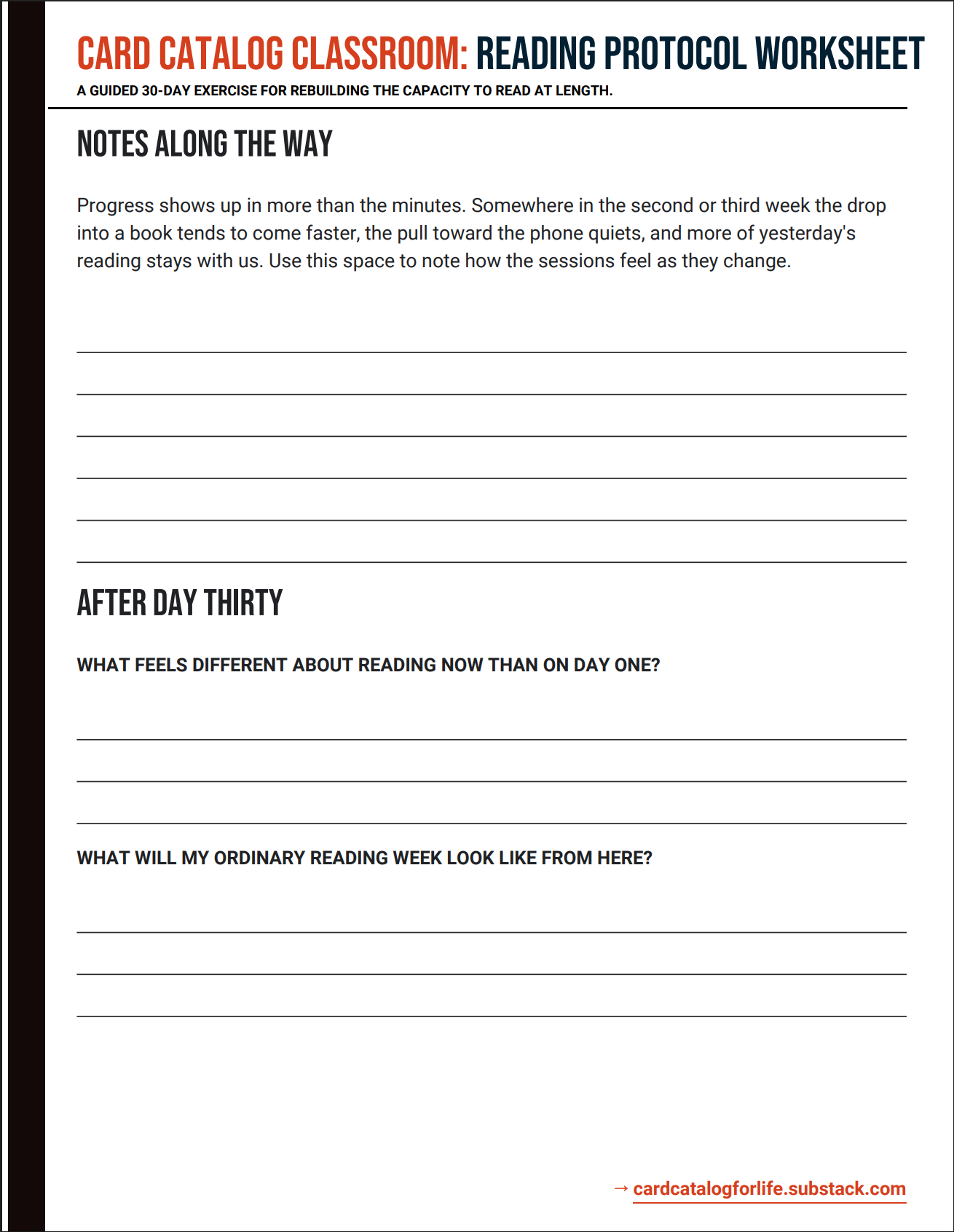
The thirty-day protocol is easier to follow with something to write on. This printable worksheet gives track one a place to record the book we’ve chosen, our start date, and the starting number we measure on day one, alongside a log that already carries the target length for every reading day so the next step is never a calculation. Rest days are marked so they read as part of the plan, there’s room to note how the sessions feel as they shift, and a closing page of reflection prompts waits at the end of the month.
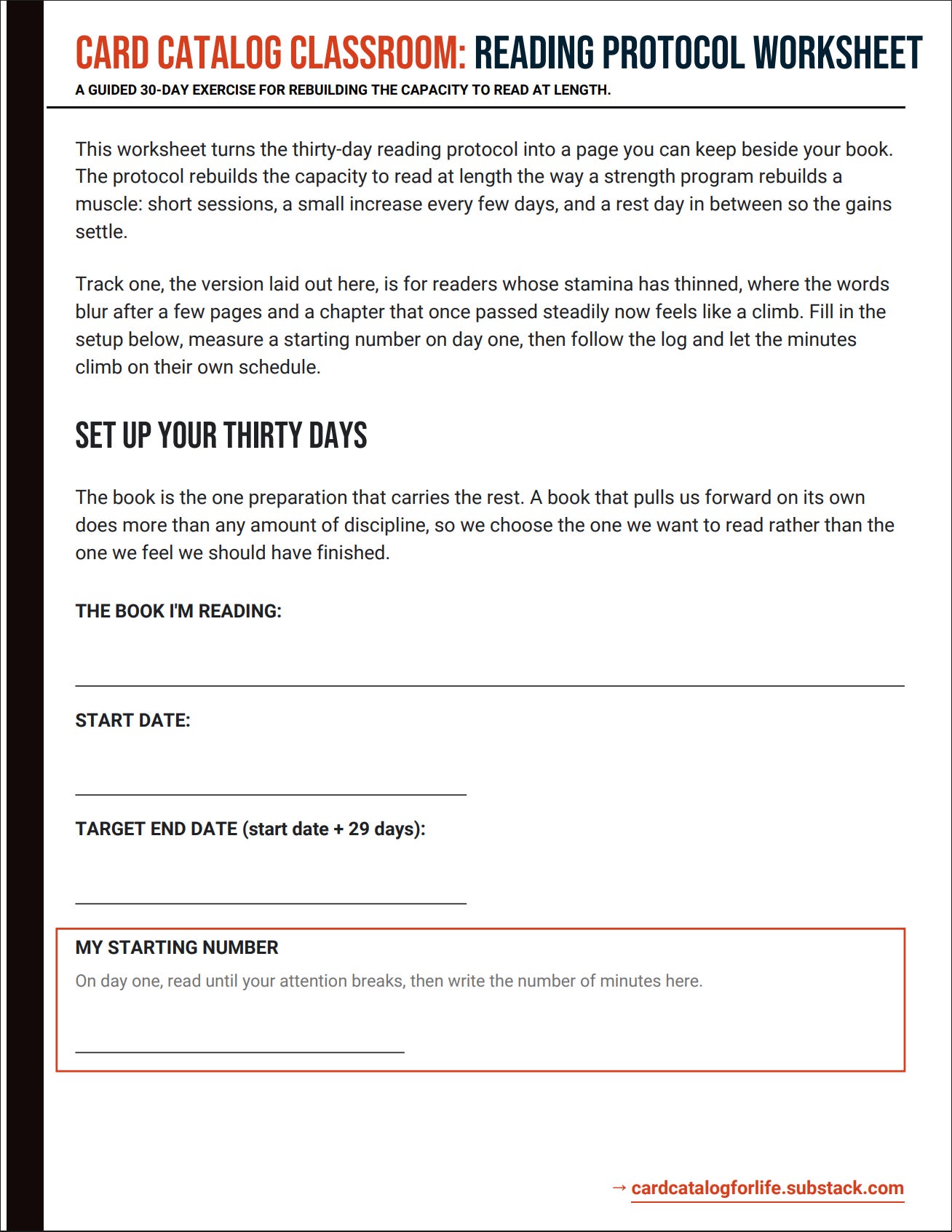
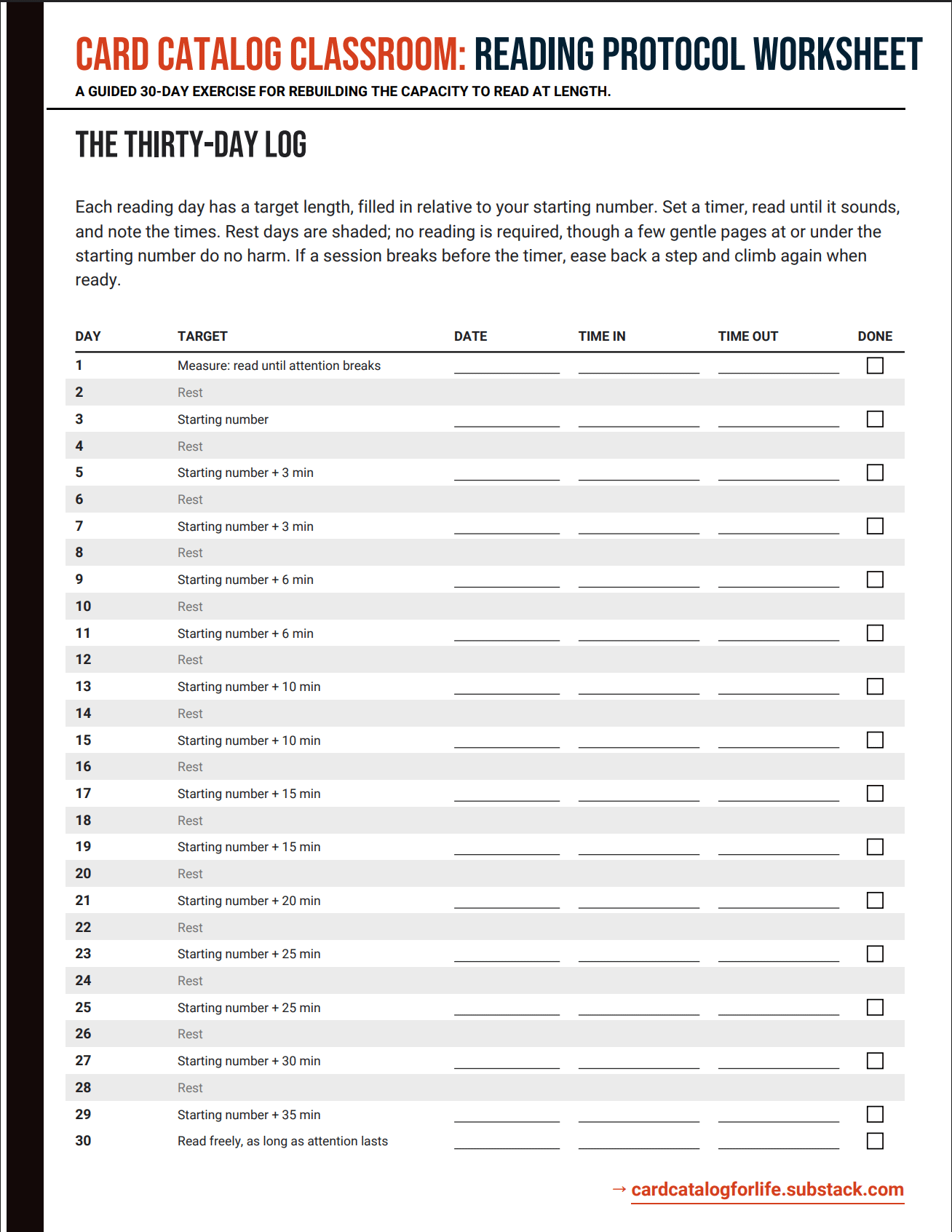

The early additions stay small on purpose. A few minutes is a large share of a short session; three minutes on top of ten asks the reading brain for about a third more than it just gave, a stretch it can rise to. But ten minutes on top of that same ten would nearly double the session in a single day, and doubling is the overreach that backfires. Later in the month the same additions come more gently, because by then each one is a smaller slice of a session that already runs long. Day thirty carries no target at all. It’s an open session, a chance to feel what our attention will do now on its own, with no clock governing the reading.
Track two: rebuilding phone-free focus
Track two usually starts from a higher number, since endurance was never the trouble. Twenty or thirty phone-free minutes is a common first reading. If our starting number sits well above ten, we treat the table’s additions as the floor and stretch them wherever the sessions feel easy.
The track two worksheet works the same way, built for readers whose stamina is intact but whose focus keeps slipping toward the phone. It records the book we’ve chosen, our start date, and the phone-free number we measure on day one, with a log that fills in each session’s target as the phone-free stretch grows longer. Rest days are marked, blank lines wait for whatever we want to record about how the reach fades, and a short set of questions closes out the month.
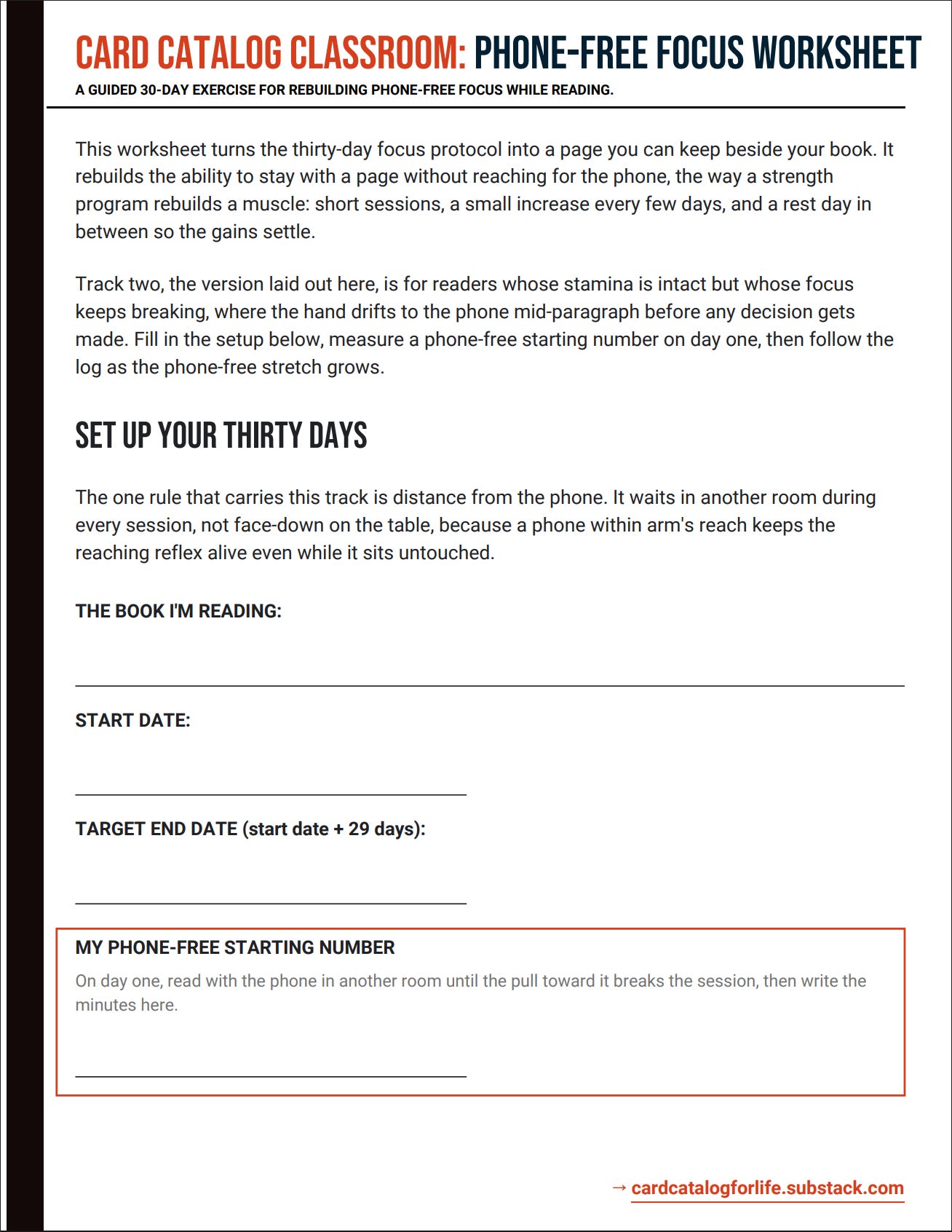
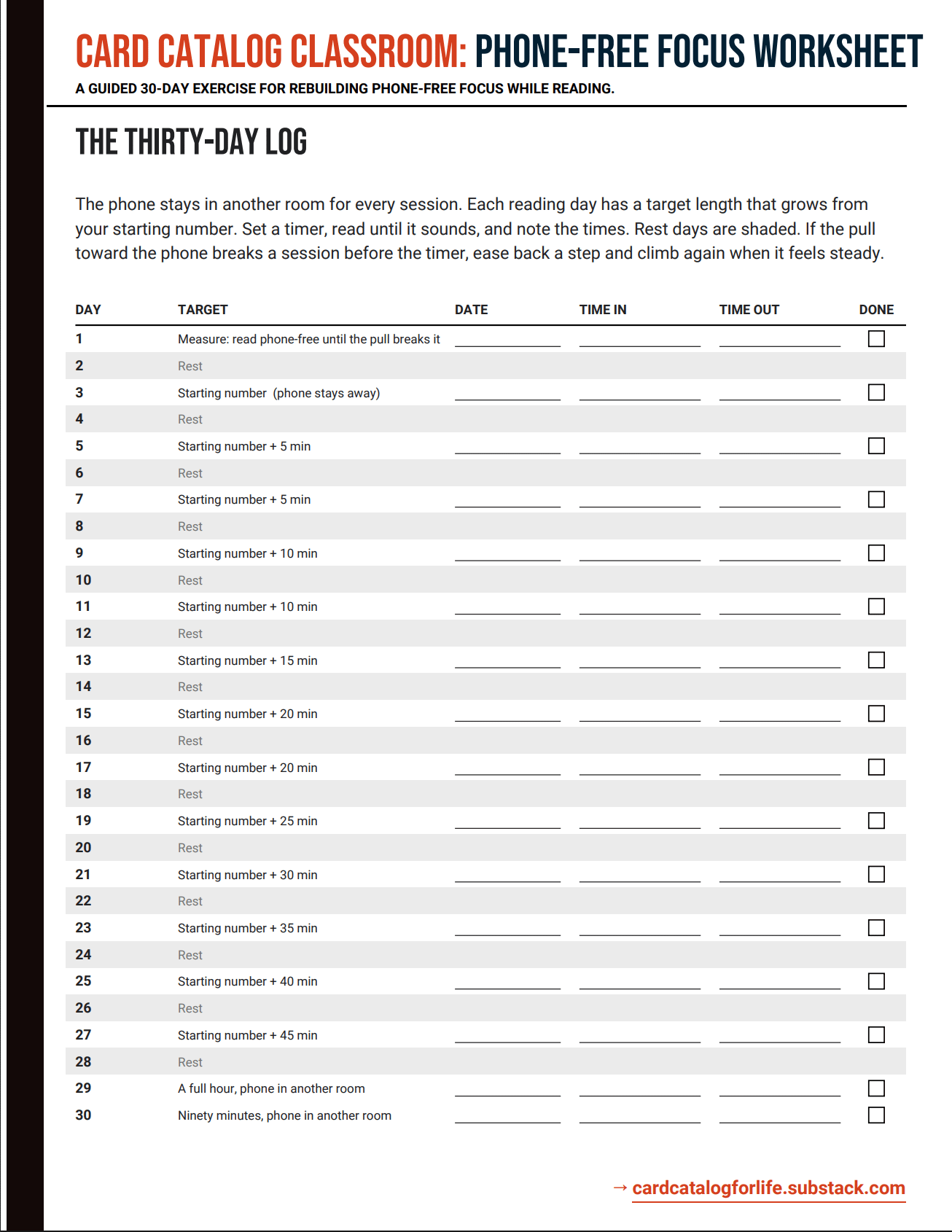
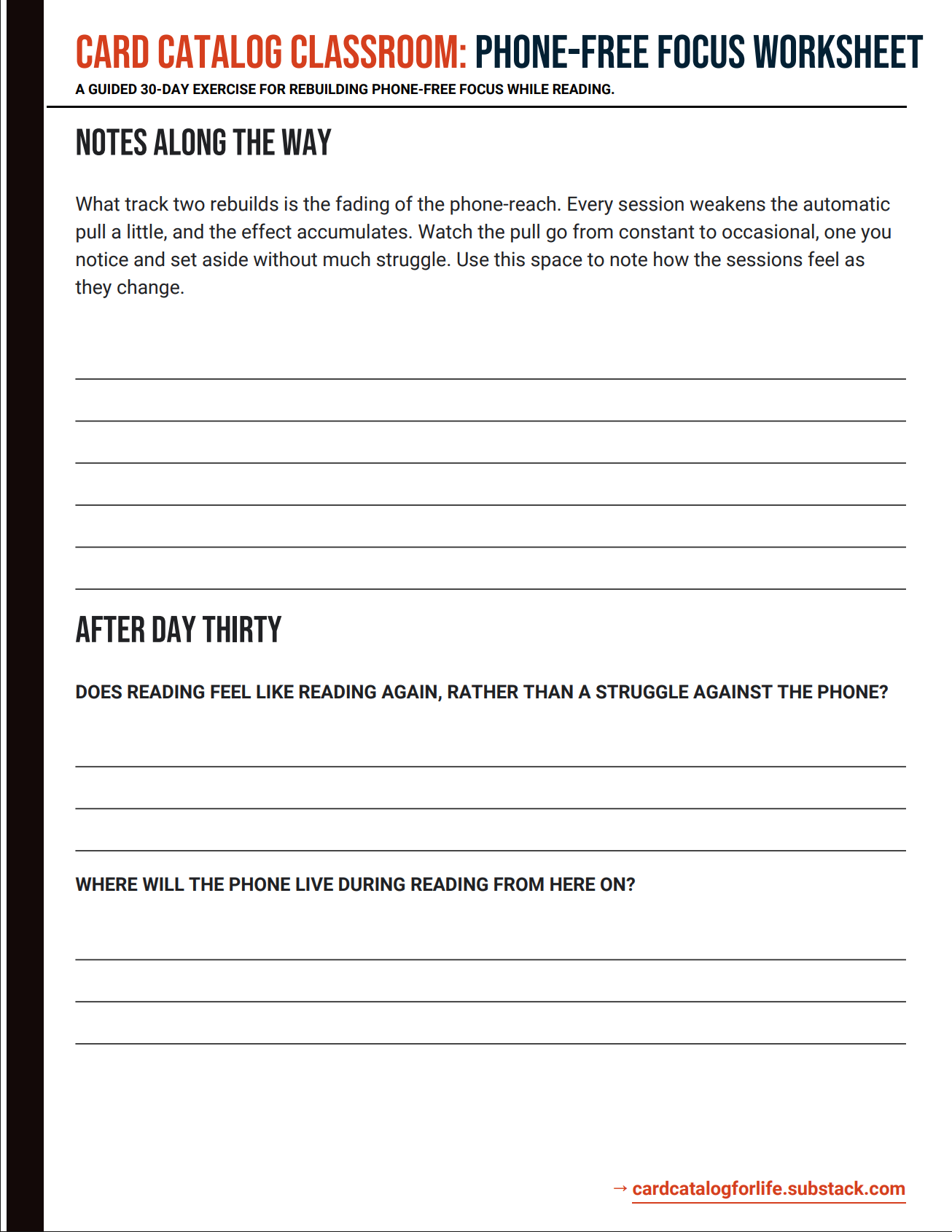
What track two rebuilds is the fading of the phone-reach. Every session weakens the automatic pull toward the phone by a little, and the effect accumulates across the month. By the final week, an unbroken hour and then ninety minutes test whether reading has gone back to feeling like reading, rather than like a contest against the phone running the whole way through. If those last sessions still feel like a fight when day thirty arrives, we give the previous length another week before calling the protocol done.
When to adjust the pace
If the additions feel steep from the start, we halve them and let the rebuild take longer. For a first session of five minutes, even a three-minute jump is a big leap, and a two-minute one may sit closer to the band where the stretch does its work. Finishing a gentle climb does more for us than abandoning a brisk one somewhere in the first week. Also, nothing about the number thirty is sacred. Thirty days is a workable default rather than a finding, and a very low starting point or a thin daily margin may call for stretching the same steps across six or eight weeks instead. The steady climb in reading time is what rebuilds the capacity, however many days it ends up taking.
And life will interrupt, because it always does. And when it does, we simply pick up at the last day we completed rather than doubling up to catch up. A missed day is a pause rather than a loss, and the sequence resumes where it left off. Doubling up to erase the gap is the overreach pattern presenting itself again in so many ways.
Signs it’s working
The minutes climbing are the easiest measure of progress, and also the shallowest one. The changes to watch for are subtler and show up in how reading feels. Somewhere in the second or third week, the drop into a book tends to come faster. The first few pages stop being a warmup we have to push through, and the text takes us in almost as soon as we sit down. The pull toward the phone, for track two readers, goes from a constant pull to an occasional one we notice and set aside without much struggle. A third sign is slower to appear and the most telling: we start remembering more of what we read the day before, because attention that stays in place long enough is what lets a page settle into memory at all. None of these arrive on a fixed schedule, and noticing even one of them means the rebuild is under way.
After day 30
Thirty days in, readers might find that their renewed capacity to stay with a book for longer stretches feels self-sustaining, and the protocol scaffolding can come down. The alternating rest days can fall away and the timer goes back in a drawer. The phone can even return to the desk, though perhaps not all the way to the reading chair. What keeps the gains from slipping is simply continuing to use it, which for most of us means sustained reading on most days, in whatever stretch of time the day allows. The capacity behaves like the strength it resembles: worked in the ordinary course of a week, it maintains; abandoned entirely for months, it thins again, though rebuilding it a second time often comes faster than the first with the muscle memory in place.
The rebuilt capacity reaches well beyond the number of books we can finish in a year. Every day now arrives as a flood of claims competing for our attention and our trust, most of them dressed as confident summaries of things we have no time to check for ourselves. Critical thinking is what lets us tell the solid claims from the flimsy ones, and it depends on a skill we rarely connect directly to it: the ability to stay with a piece of writing long enough to weigh what it says and test its logic. A mind that can follow a long argument will follow it down to the assumptions it rests on, where the deepest disagreements usually hide. That same mind can carry two accounts of the same event at once, reading them against each other until the point where they divide comes into view. It can catch the paragraph that contradicts what an earlier one promised. None of this is possible without deep reading. Skimming takes the gist and moves on, which means it takes the summary someone else prepared and moves on, leaving us knowing whatever that person wanted us to know.
That capacity is the ground beneath the whole discipline of reading well. Weighing whether a source can be trusted, or tracing a claim back to the study it came from, depends first on being able to read the thing deeply at all. The judgment we bring to information rests on an attention that can stay in one place, and that attention is what these thirty days rebuild. A reading life that began as a private pleasure turns out to underwrite an independent mind, the difference between examining the world for ourselves and accepting the version we’re handed. That is the deeper measure of the rebuild. The stamina returns first, and the critical thinking that rides on it follows close behind.

A few readers have asked how to support the work outside of a subscription, so here’s another option. If something here has resonated with you or been helpful, this is one more way to show appreciation. Thank you for reading, always.
You might also like:
What Scrolling Did to Reading: Why books feel harder, what the science shows, and how to rebuild the capacity.
Misinformation Spreads at the Speed of Impatience: Why critical thinking starts with slowing down, according to the research.
Steel-Manning Can Be More Useful Than Fact-Checking: How engaging with the strongest version of an opposing argument builds a deeper defense than verification alone. A practical guide with a downloadable worksheet.
The free essays are the foundation. The paid tier is where information literacy becomes a skill you can use: the Card Catalog Classroom with its searchable Reference Collection and structured lessons across four learning domains, plus biweekly AI Briefings, monthly Librarian Hotlines, and quarterly deep-dive guides.
Upgrade to paid for the full Card Catalog. Thank you for being here!